
Should I Wear Silver or Gold Jewelry? Three Tests That Decide It
A five-minute test for gold vs silver jewelry: wrist veins, daylight metal check, and wardrobe match, plus a photo-based double-check.

Written by
The Aurcue editorial team writes practical guides to personal style, color, outfits, hairstyles, and glasses. Articles use source research and quality review, with product guidance checked against the current Aurcue experience.
By Aurcue Editorial Team
You're at a jewelry counter, or looking at a product page with a gold swatch and a silver swatch, and you only want to know one thing: which one suits me? You can answer that without a quiz and without buying anything. All you need is a window, a phone camera, one gold-tone piece and one silver-tone piece you already own. Run the three tests below in order. Each one takes about a minute, and you finish with a metal rule you can apply the next time you shop.
Short answer: Start with gold if your wrist veins look green, a gold piece makes your skin look more even in daylight, and your closet runs to camel, rust, olive and brown. Start with silver if your veins look blue or purple, silver looks cleaner against your skin, and you mostly wear navy, gray, white and denim. If the tests split, the section on mixed results shows how to decide, or how to wear both on purpose.
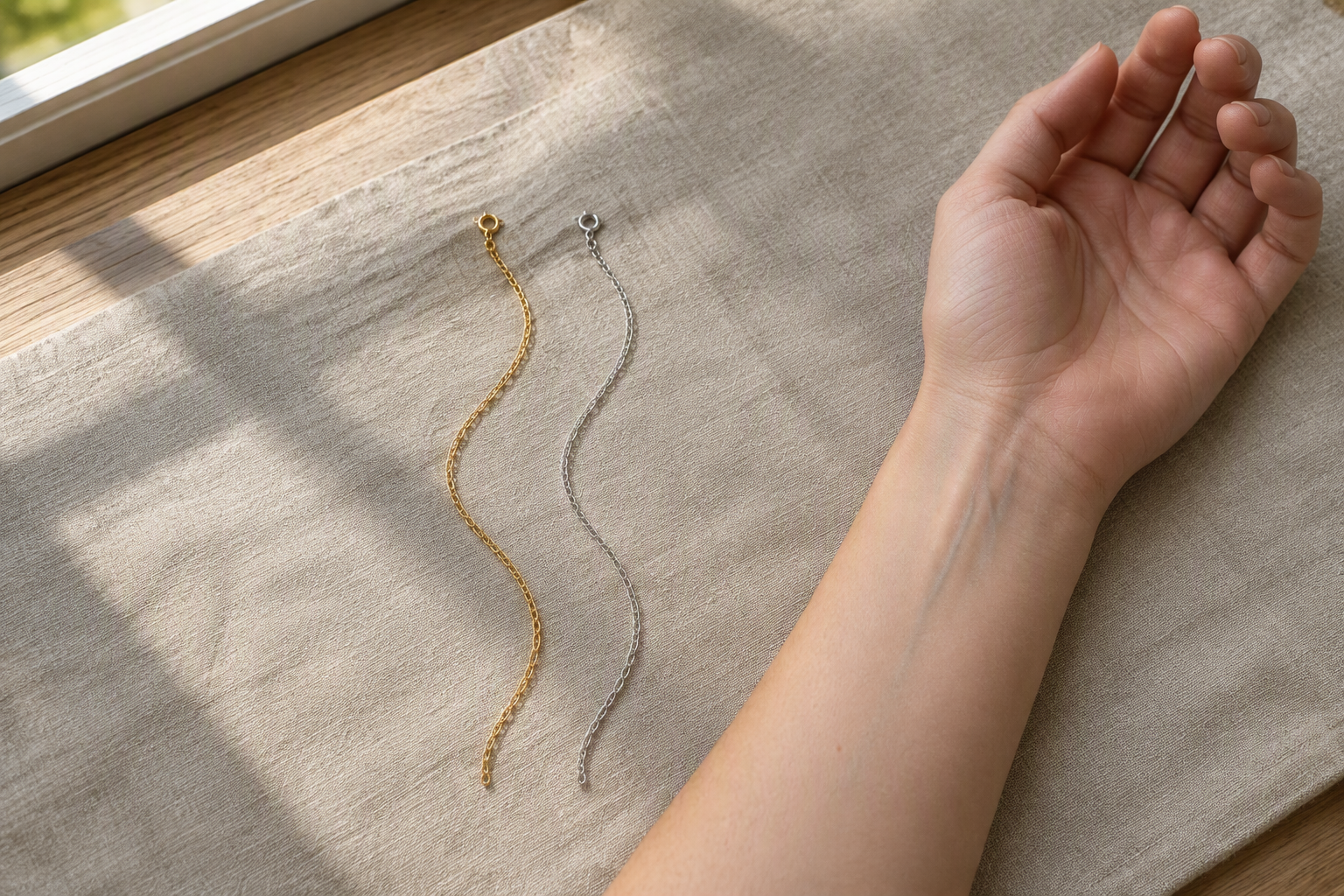
Test 1: the wrist-vein check (10 seconds)
Turn your wrist palm-up next to a window and look at the veins in daylight. Jewelry guides from Jennifer Fisher and Blue Nile read the result the same way:
| What your veins look like | Undertone it suggests | Metal to try first |
|---|---|---|
| Green (or greener than blue) | Warm | Gold (yellow or rose) |
| Blue or purple | Cool | Silver, white gold or platinum |
| A mix of blue and green | Neutral | Both |
Treat the result as a first hypothesis, not a verdict. Blue Nile describes vein color and similar signs as general indicators rather than strict rules, and Excitare's silver-vs-gold guide calls the vein test imperfect and recommends treating it as a rough clue. Veins can be hard to read, and indoor lighting can cast warm or cool hues that change what you see. If your answer is "I honestly can't tell", write "unclear" and move on. Test 2 gives you a more direct look at the metal itself.
If you want the longer explanation of undertone, contrast and clarity, our skin tone color palette guide for clothes covers it. This article sticks to the metal decision.
Test 2: hold each metal to your face in daylight (about 1 minute)
This is a practical visual check, because it shows the actual metal against your actual skin. Blue Nile's guide says daylight gives the most accurate view of how each metal interacts with your skin, while indoor lighting can cast warm or cool hues that distort the result.
- Clean both pieces first. Blue Nile points out that buildup or residue changes how metal reflects light. A quick wipe with a soft cloth is enough.
- Face a window so the light falls evenly on your face. Turn off warm room lights if you can.
- Hold the gold piece near your jaw or collarbone (a chain, earring or ring held up to the cheek all work) and take a photo with your phone.
- Swap to the silver piece and take a second photo from the same spot and angle, within the same minute, so the light doesn't change between shots.
- Put the two photos side by side and compare your skin, not the jewelry.
What you're looking for:
| Usually a sign the metal works | Usually a sign it's working against you |
|---|---|
| Your complexion looks more even and balanced | Skin around the jaw looks patchier or flatter than in the other photo |
| The metal looks connected to your skin | The metal looks like it's sitting on top of you |
| Your eyes and features look clearer | Your face reads duller next to the shinier metal |
Blue Nile describes the winning metal as the one that makes your complexion look more even and balanced, and Excitare recommends choosing the piece that makes your skin look clearer. Neither is a quality judgment of your face. Treat it as a contrast question: which metal sits better against your coloring in this light.
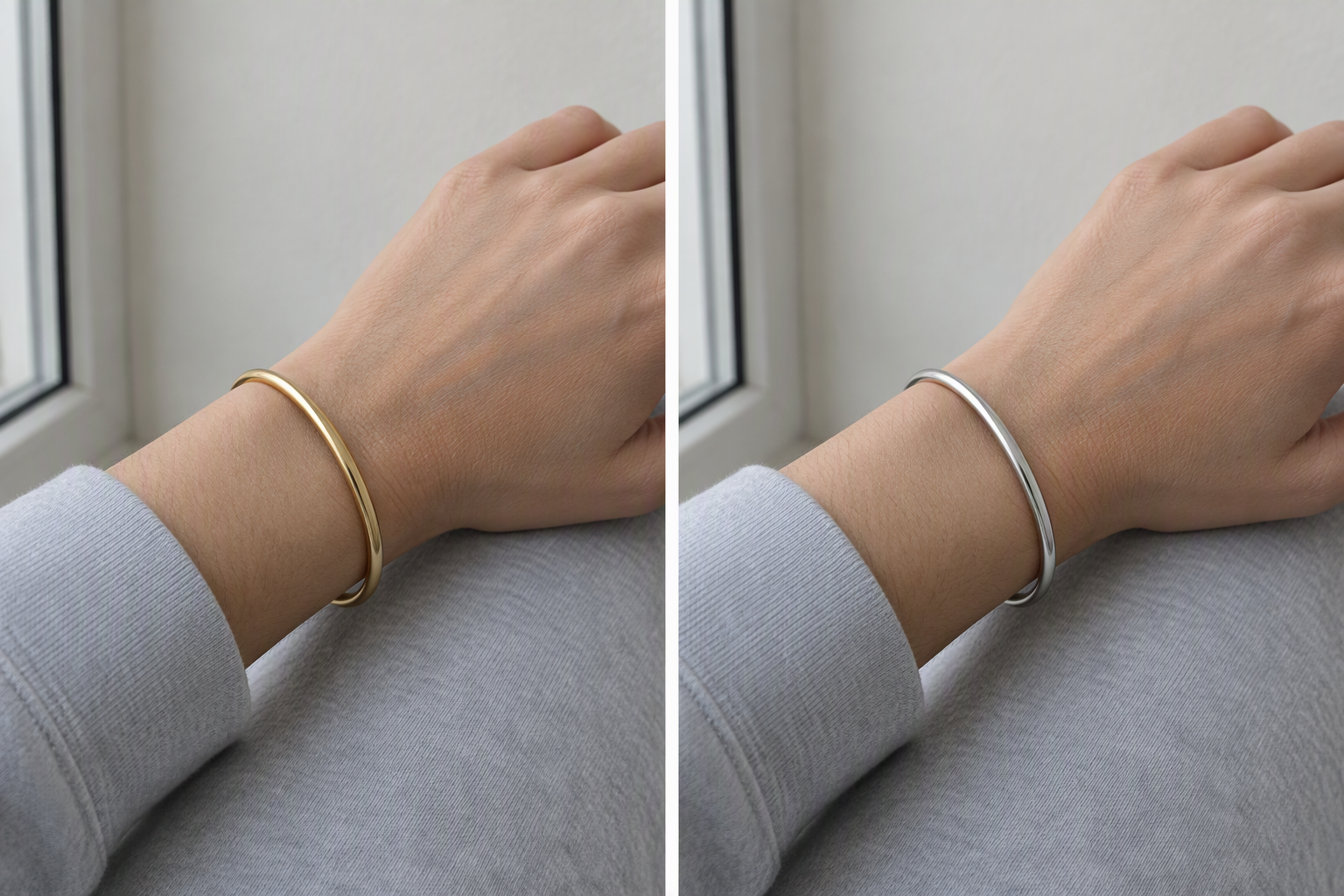
Editorial illustration, not a real test photo: it shows the setup to copy (same light, same angle, only the metal changes). Your own two photos are the evidence that counts.
One more note from Excitare that's worth keeping: contrast isn't a mistake. Someone with cool undertones can deliberately wear gold for warmth, and someone with warm undertones can choose silver for a cleaner, sharper effect. Test 2 tells you which metal blends in; you still decide whether you want blend or contrast.
Test 3: the wardrobe match (about 1 minute)
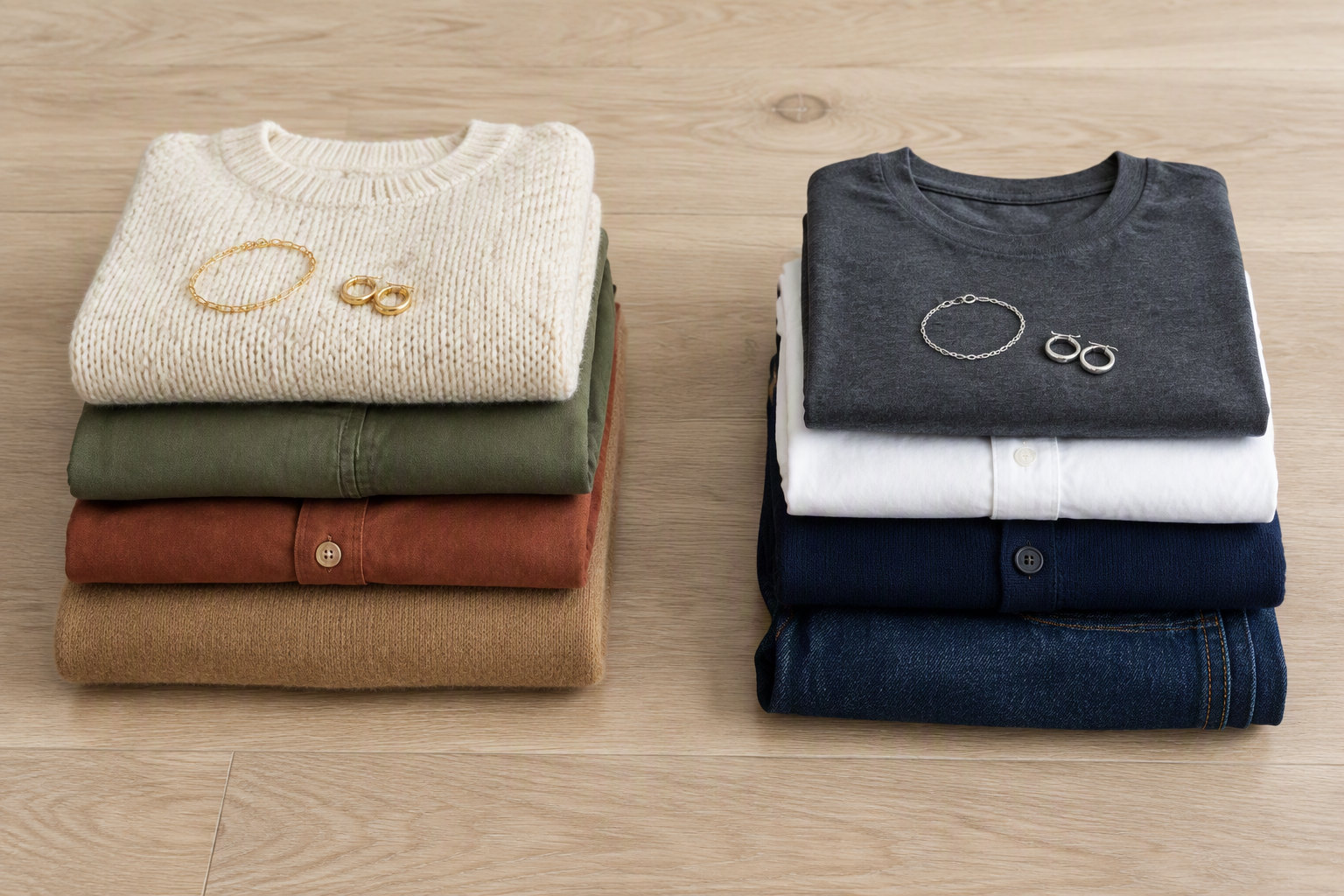
Your closet is the tiebreaker. Think of the five pieces you wore most in the last two weeks, the real rotation and not the outfit you wear once a year, and tally which way they lean.
| Most-worn colors | Metal lean | Source |
|---|---|---|
| Camel, brown, rust | Gold | Jennifer Fisher |
| Cream, beige, olive | Gold | Excitare |
| Blue, gray | Silver | Jennifer Fisher |
| Black, white, navy, denim | Silver, but flexible | Excitare and Blue Nile |
The last row needs a footnote. Excitare puts black, white, gray, navy and denim on the silver side. Blue Nile treats white, cream, navy and black as neutrals that work with both metals. So if your top five are all black and navy, your wardrobe isn't pushing hard either way, and Tests 1 and 2 should decide. If most of your five clearly sit in the warm rows or in the blue-and-gray row, treat that as a wardrobe lean. That cutoff is our own rule of thumb, not a rule from the cited guides.
Two quick extra checks from Jennifer Fisher's and Excitare's guides: look at the hardware you already own. If your watch, bag hardware, zippers or glasses frames are mostly one metal, jewelry in that metal joins the outfit with no extra effort.
When the tests disagree
A simple rule of thumb (ours, not from the cited guides): if two tests point to the same metal, treat that as your lead metal. When you need a tiebreaker, lean on Test 2, because it's the only one that shows the metal on you.
If you still don't have a clear answer, one of these situations may apply.
Neutral undertone. Your veins look mixed and both metals look fine in the photos. Blue Nile says neutral undertones typically suit both gold and silver, so you can choose by outfit or occasion. Jennifer Fisher's guide says the same: neutral undertones can wear both and can try mixed-metal pieces.
Olive skin. Excitare notes that gold often complements the warm or green notes in olive skin, while silver creates a cooler, sharper contrast, and that both can work. If Test 2 shows silver looking good, you haven't misread yourself. You may just prefer the sharper look.
You like both. Then wear both on purpose. The mixing rules from the ranked guides are consistent:
- Let one metal lead and use the other as an accent (Excitare).
- Repeat both colors rather than wearing a single odd-one-out piece (Excitare).
- Keep shape, texture or scale in common so the pieces look related (Jennifer Fisher).
- Anchor the look with a two-tone bracelet or mixed-metal ring that contains both colors (Jennifer Fisher).
Turn the answer into a shopping rule
The point of the tests is to make the next purchase easier. Turn your result into a rule you can apply to any product page:
- Buy face pieces in your lead metal. Blue Nile notes that earrings and necklaces sit closest to your face, so their metal tone has the most visible impact. These are the pieces where the test result matters most.
- Rings and bracelets can follow your watch and hardware. Excitare suggests checking the metal you already wear, because repeating one tone helps an outfit look intentional.
- Statement and everyday pieces can differ. Blue Nile observes that larger pieces amplify the metal's effect while delicate ones read as subtle, so you might wear one metal for statement pieces and another for everyday.
- Read the material line separately from the color. Excitare points out that "silver" and "gold" often describe the appearance, not the full material: a silver-tone piece can be stainless steel or sterling silver, and a gold-tone piece can be solid gold, gold-plated or PVD-coated. The tests in this article only decide the color. Price, durability and plating are a separate question.
A rule you can copy into your notes app:
My lead metal is [gold / silver]. Earrings and necklaces: [lead metal]. Rings and bracelets: match my watch. One accent piece in the other metal is fine if it shows up twice in the outfit.
None of this needs a bigger budget. Run the tests with pieces you already own, and pick a gold one and a silver one that are close in size, shape and finish so the comparison is fair. Blue Nile notes that the type of metal, such as solid versus gold-plated jewelry, can affect what you see, so treat a test with plated or costume pieces as a first read, not a final answer.
Check it against a photo instead of guessing
The three tests depend on your own eyes, and it's hard to be neutral about your own face. If your result still feels like a coin toss, a second read from your actual photo can help.
Aurcue's AI Personal Color Analysis turns a clear photo into a practical color report with palette direction, best neutrals and colors to avoid. Our skin tone photo guide describes the kind of comparison it is meant to help with, such as cream or white, charcoal or camel, gold or silver. Use the same setup as Test 2 for the upload: a front-facing photo in window light, no heavy filter. Then check the report's warm, cool or neutral read against your three test results.
Know what it isn't. The report gives style guidance on color. It is not a review of a jewelry piece's quality or price, and it doesn't diagnose skin or score how you look.
FAQ
Do I look good in gold or silver?
Start with whichever metal wins two of the three tests above. The daylight photo comparison (Test 2) is a practical visual check because it shows the metal against your real skin. If both look equally good, either is a reasonable style choice; this comparison alone does not establish your undertone. For more on reading your coloring from a photo, see What Skin Tone Am I?
Can I mix gold and silver jewelry?
Yes. Let one metal lead, repeat the accent metal at least once so it looks deliberate, and keep shapes or scale in common. A two-tone piece that contains both colors ties the look together. Jennifer Fisher's guide suggests starting small, for example a silver chain with a gold pendant.
What is the healthiest jewelry to wear?
The main material question is metal allergy. DermNet, the dermatology reference, says most jewelry allergy is caused by nickel and cobalt. It also notes that many people who think they're allergic to gold or silver are actually reacting to nickel, which can occur as a trace element or be added to whiten and strengthen gold. White gold is usually alloyed with nickel and often rhodium-plated, and that plating eventually wears off. Silver-plated jewelry has a base metal that may contain nickel, and some sterling silver can contain traces of it. DermNet lists stainless steel, at least 18-karat gold, sterling silver and polycarbonate plastic as hypoallergenic choices. For a jewelry allergy, DermNet says treatment requires removing the responsible jewelry, and a dermatologist can do a patch test to confirm a metal allergy. This is a materials note, not medical advice.
Does metal choice matter with glasses?
It can. Metal frames count as part of your jewelry. Excitare notes that a silver glasses frame or watch gives silver jewelry an immediate connection. Our guide to choosing glasses from a photo lists silver, gold, champagne and gunmetal among the frame colors worth comparing. If you wear glasses daily, run Test 2 with them on, and consider frames in your lead metal.
A note on limits
This guide is about style, not health. The vein test and the daylight check are visual style heuristics. They don't measure anything medical, and lighting, cameras and makeup can shift what you see. Personal preference still counts. As Blue Nile puts it, a well-designed piece can look great even when it breaks the usual guidelines.
Sources
- Jennifer Fisher, Should I Wear Silver or Gold Jewelry? Find Your Perfect Metal
- Blue Nile, What Suits You Best? Take the Silver or Gold Jewelry Test
- Excitare Studios, Silver vs Gold Jewelry for Men: Which Suits You Best?
- DermNet, Jewellery allergy
- Aurcue, Skin Tone Color Palette for Clothes
- Aurcue, What Skin Tone Am I? Use Photo Clues Without Guessing Your Undertone
- Aurcue, What Glasses Suit My Face? Upload Photo Guide